
Cauvery Dispute: Vijay's Talks Gambit | UPSCPDF
UPSCPDF Editorial Analysis: TN CM Vijay
Key Takeaways | Quick Facts Box | Evolution of the Cauvery Dispute | Core Analysis — Why This Gambit Matters | Constitutional & Legal Foundations | The Institutional & Policy Architecture | Supporting Schemes & Frameworks | Comparative Best Practices | Marks Breakdown | More Mains Angles (Multi-GS) | Additional Essay Angles | Key Actors & Stakeholders | Quick Revision Tags | 📚 Explore More UPSC Editorial Analyses | 🇮🇳 UPSCPDF Editorial Analysis
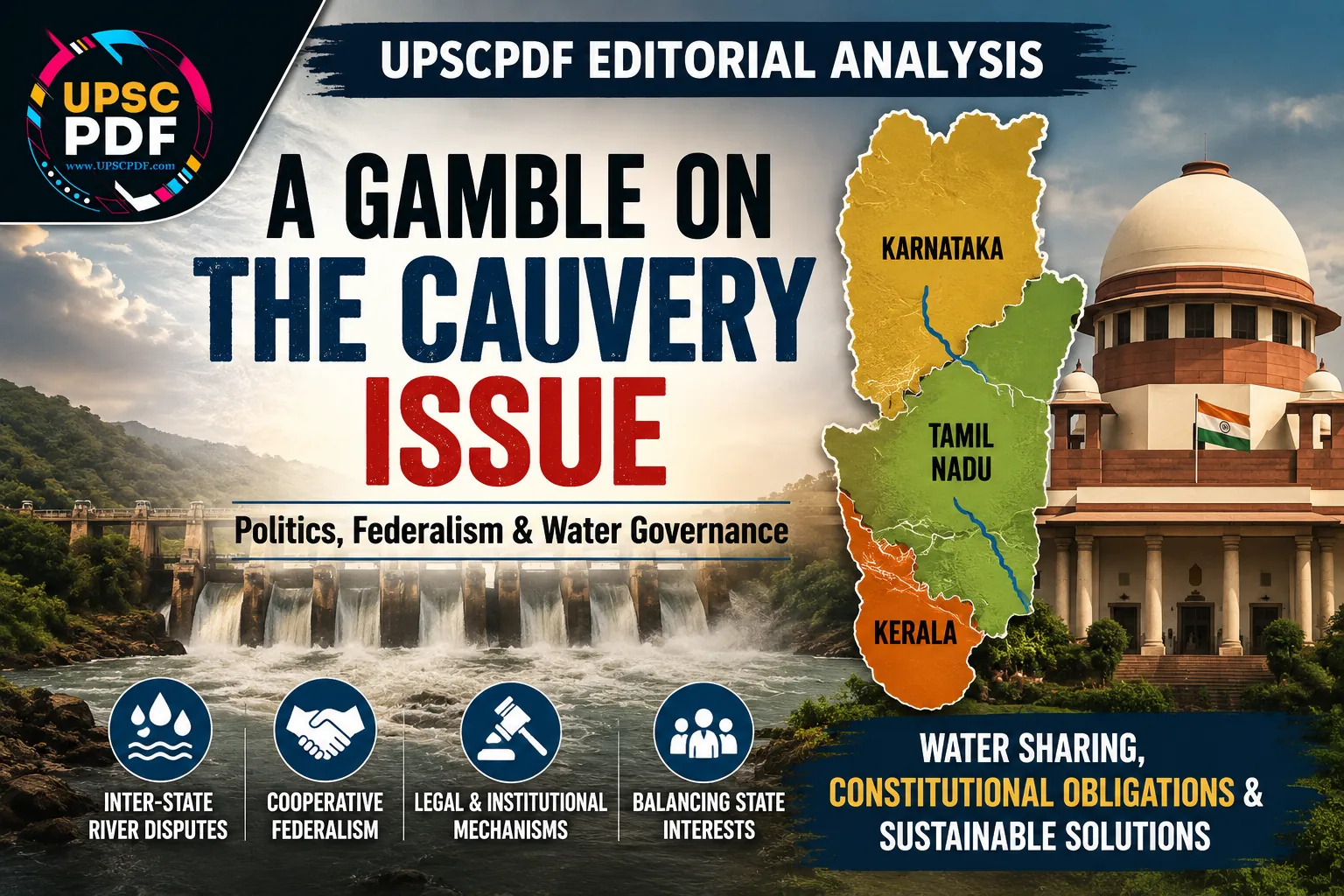
Adjudication versus dialogue — decoding a Chief Minister's departure from Tamil Nadu's 35-year litigation playbook, the institutional stakes for the CWMA, and what a distress-sharing formula could mean for India's most protracted river-water dispute. Tamil Nadu Chief Minister and Tamilaga Vettri Kazhagam (TVK) president C. Joseph Vijay has decided to initiate direct bilateral talks with his Karnataka counterpart, Deputy CM D.K. Shivakumar, on the Cauvery water-sharing issue. The move is a marked departure from Tamil Nadu's traditional policy of pursuing adjudication through the Cauvery Water Disputes Tribunal (CWDT) and the Supreme Court. The trigger is acute distress: between 1 June and 23 July 2026, Tamil Nadu received only about 3.5 tmc ft against a stipulated share of roughly 32 tmc ft, amid a deficient south-west monsoon over the river's catchment. Critics — opposition parties, farmers' leaders and water experts — warn that direct negotiations risk bypassing the Cauvery Wate
⏱ Reading time: ~29 min