

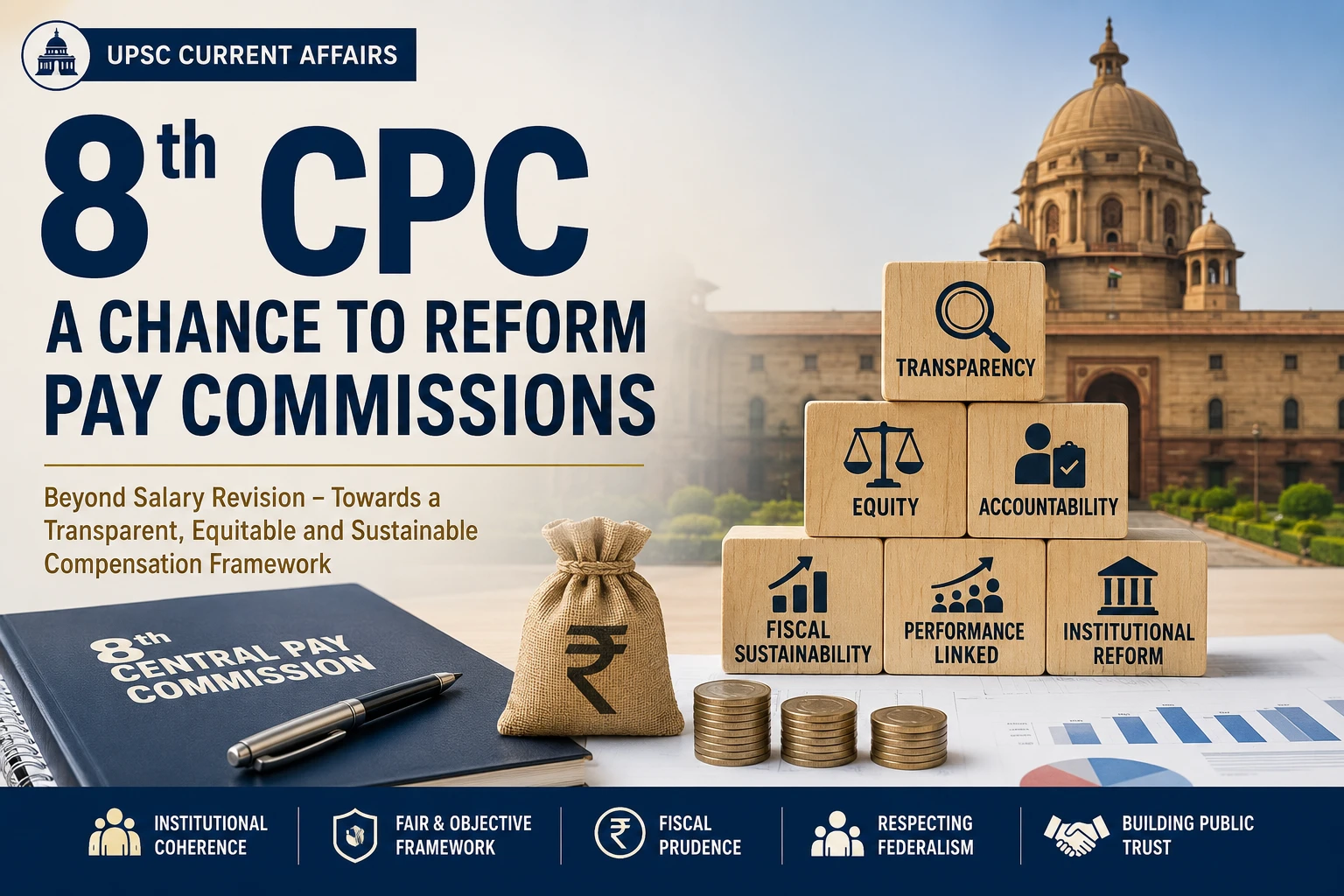
8th Pay Commission | UPSC GS-2 & GS-3 | UPSCPDF
UPSCPDF Editorial Analysis of the 8th Central Pay Commission: pay & pension reform, NFU, Unified Pension Scheme, fiscal sustainability, governance. MCQs, Mains, Essay, Interview.
💡 Key Takeaways | 📖 What is a Central Pay Commission? | ⏳ Evolution of Pay Commissions in India | ⚖️ Constitutional & Legal Framework | 🧩 Core Concepts to Master | 🛠️ Key Reform Dimensions for the 8th CPC | 📊 Marks Breakdown | 🧩 Key Dimensions | 📐 Additional Essay Angle Cards | 👥 Key Actors & Stakeholders | 🗂️ Quick Revision Tags | 🇮🇳 UPSCPDF Editorial Analysis
From a decadal salary-revision ritual to structural reform of India's public compensation architecture — inter-service parity, allowance rationalisation, Non-Functional Upgradation, pension sustainability & the case for a permanent National Compensation Authority. The 8th Central Pay Commission (CPC) has been formally constituted by the Union Government, with the Cabinet approving its Terms of Reference (ToR). The Commission is chaired by former Supreme Court judge Justice (Retd.) Ranjana Prakash Desai, with an IIM Bangalore professor as part-time member and a senior IAS officer as Member-Secretary. It is expected to submit its report within 18 months of constitution, and its recommendations are widely expected to take effect from 1 January 2026 — continuing the broad ten-year revision cycle (the 7th CPC took effect on 1 January 2016). Beyond the headline question of "how much will salaries rise," commentators argue the real opportunity is structural reform. The current framewo
⏱ Reading time: ~37 min